
The TEFLIN (Teaching English as a Foreign Language in Indonesia) Conference, one of the most prestigious annual events for English Language Teaching (ELT) professionals in Indonesia, was held on October 8–11, 2025, at Brawijaya University, Malang. This annual conference is highly anticipated by English Language Teaching (ELT) scholars from across Indonesia and abroad.
This year’s conference featured the Minister of Primary and Secondary Education, Prof. Abdul Mu’ti, along with two distinguished professors, Prof. Gary Barkhuizen from the University of Auckland and Prof. Ju Seong Lee from the Education University of Hong Kong. The plenary speakers included Assoc. Prof. Hamamah from Brawijaya University, Prof. Young-Joo Jeon from Mokwon University, Korea, Prof. Kyria Rebecca Finardi from Universidade Federal do Espírito Santo, Brazil, and Assoc. Prof. Dennis Alonzo from The University of New South Wales, Australia.
The grand theme of this year’s TEFLIN Conference was “Reimagining English Language Education in the Age of AI and Digital Transformation: Integrating Inclusive Education and Cultural Diversity.”
In this opportunity, LC UMM was represented by its secretary, Bramy Biantoro, M.Ed., and four instructors, Dadang Zakaria, M.Pd., Maula Khoirunnisa, M.Pd., Metaria, M.Pd., and Pritha Anggiarima, M.Pd.
Mr. Bramy presented his paper entitled “Exploring Students’ Perceptions and Experiences of Gamified Blended Learning in an Extracurricular English Speaking Club: Student Insights from a Junior High Extracurricular English Club in Indonesia.” The study found positive impacts of gamified blended learning, which improved junior high school students’ motivation, engagement, and language skills. Flexible, game-based tasks encouraged self-paced learning and enjoyment, and assignment scores showed consistent improvement over time. However, some challenges and feedback were identified. Technical issues and increased workload tested students’ persistence. Students suggested device optimization and more varied activities. Future research and practical implications call for an expanded participant base, including teacher perspectives, and the use of comprehensive assessments to validate and refine the model. Overall, the study highlights the promise of inclusive and motivating language education in resource-limited settings.
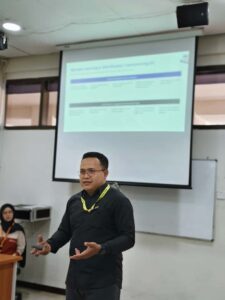
Mr. Dadang Zakaria presented a paper entitled “AI-Powered Reading Strategy Training: Using Manipulation Techniques to Prepare EFL Learners for Standardized English Tests.” His research revealed that AI-powered manipulation strategy training is a highly effective approach to significantly improving EFL learners’ reading comprehension and standardized test performance. For educators, he emphasized that AI should serve as a powerful augmentation tool, enhancing pedagogical practices and learner outcomes rather than replacing human instruction. The findings strongly support a pedagogy-first AI integration, focusing on how AI can best serve educational goals.
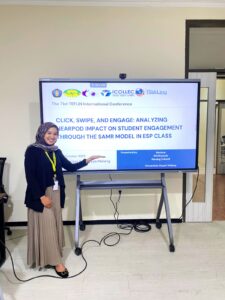
Miss Metaria presented a paper entitled “Click, Swipe, Engage: Analyzing Nearpod’s Impact on Student Engagement through the SAMR Model in ESP Class.” Her findings showed that Nearpod activities operated at the augmentation and modification levels of the SAMR model, significantly enhancing behavioral, emotional, and social engagement. These activities fostered active participation, emotional investment, and interpersonal interaction within the learning environment. However, few activities reached the redefinition level, limiting their effect on deep cognitive engagement. This highlights the need for further exploration and instructional refinement to maximize cognitive engagement.
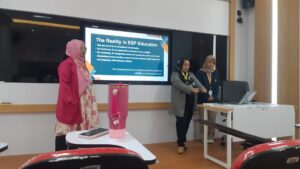
Miss Pritha Anggiarima and Miss Maula Khoirunnisa jointly presented a paper entitled “ESP Lecturers’ Perspective on Students’ Utilization of AI in the Classroom.” Their research found that AI is beneficial for brainstorming, material development, and grammar checking. However, they also described AI as a “double-edged sword,” posing significant risks to academic integrity and critical thinking skills. Despite AI’s advances, human lecturers remain essential for providing emotional support and creating authentic learning experiences. In the future, AI use in education requires careful guidance, ethical frameworks, and a balanced approach to harness its benefits while mitigating its drawbacks.
The conference provided numerous valuable insights related to the integration of AI in English Language Teaching, many of which can be applied to FLSP (Foreign Language for Specific Purposes) teaching activities. Beyond academic enrichment, the event also fostered networking with scholars nationwide and helped refine the instructors’ research and academic writing skills, essential assets for their future professional growth. (pa)